
Hitherto hath the Lord helped us
Our history
Salem means Peace with God through Christ. Ebenezer means Rock of Help. Christ is our Rock of Help.
Salem Ebenezer
Our German Reformed ancestors found God’s peace and His constant rock of help as they established this congregation in 1854. For more than a century and a half the members of this church have traveled through this world as members of this community.
We need the salvation from our sin that only Jesus has won for us. Through biblical worship, study, and fellowship, we continue to celebrate the fact that our only comfort in life and in death is that we belong to our faithful Savior Jesus Christ.
“Reformed” identifies us as members of the Reformed Church in the United States, whose roots go back to the 16th-century Protestant Reformation. God raised up men like Luther, Zwingli, Knox, and Calvin, who reformed the church according to the Word of God alone. They recaptured the eternal truths that Christ alone is our full Savior, who saves us by grace alone through faith alone, all to the glory of God alone.
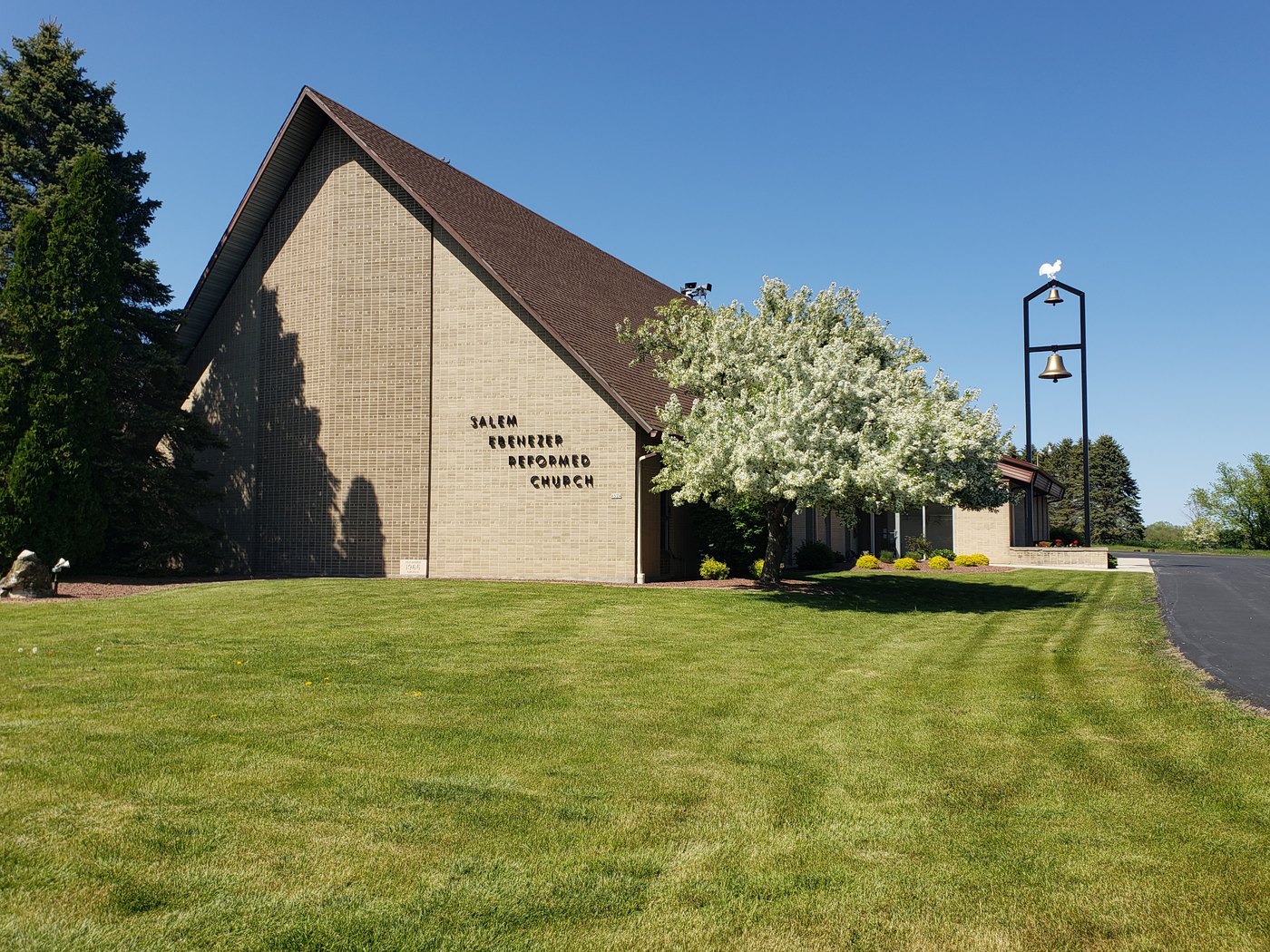
What’s in a Name?
Salem means peace — peace with God through Christ. Ebenezer means Rock of Help. Christ is our Rock of Help.
A local name
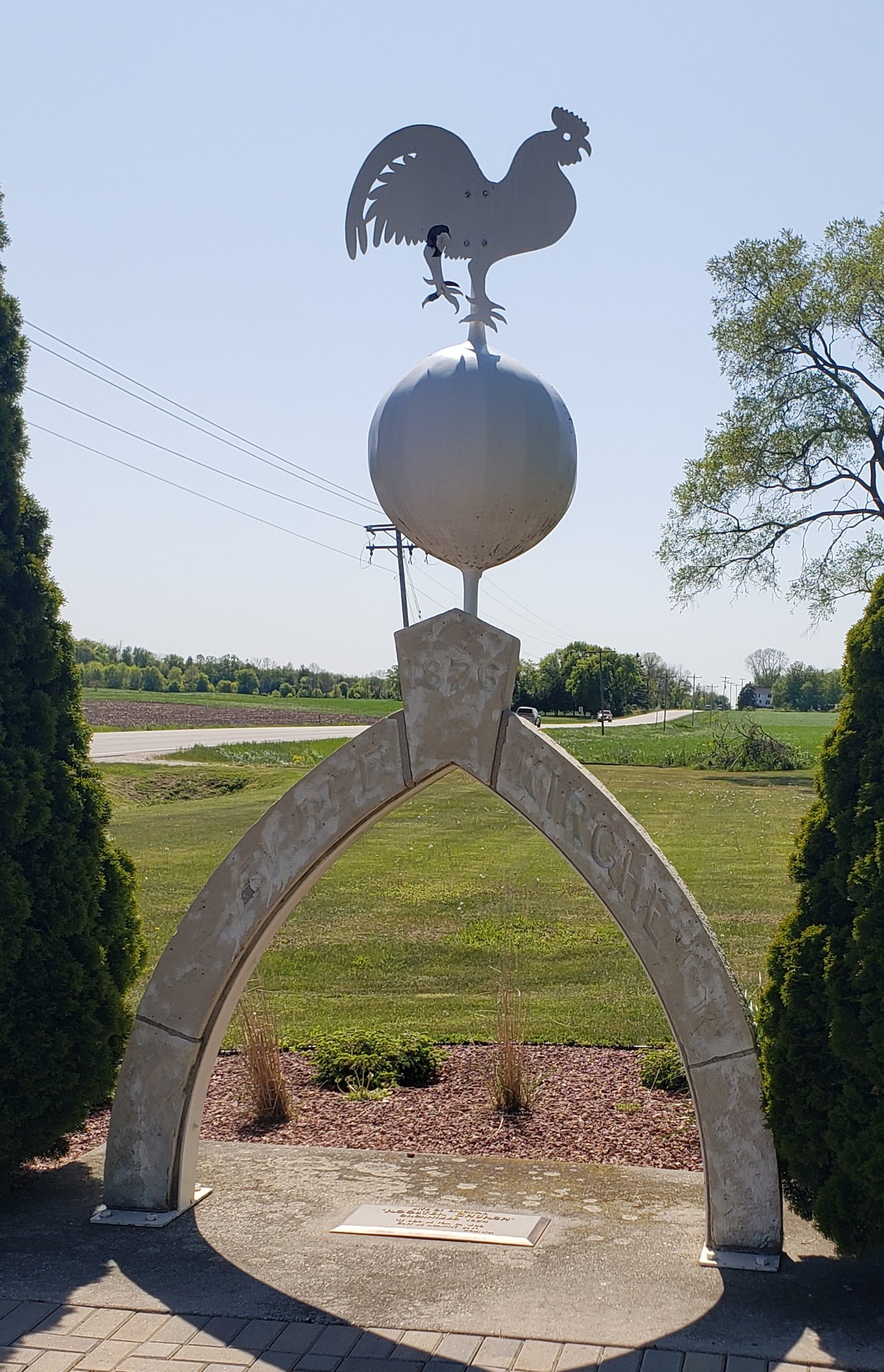
Rooster Church — what does that mean?
Neighbors have long called this the Rooster Church because of the rooster that stands above the bell. In the churches of the European Reformation, the rooster was set over the meeting house as a call: “Wake up to the Truth of God’s Word!”
The bird still stands over County Road C. It is not an ornament. It is a sermon in metal — calling this congregation to watchfulness, to the Word, and to the dawn of the resurrection.
The Reformed Church in the United States
RCUS Heritage
Who We Are — What We Are — Why We Are
The present-day Reformed Church in the United States (RCUS) is the continuing remnant of the German immigrant denomination of the same name which was founded in 1725 by the Rev. John Philip Boehm. The old RCUS continued as a separate denomination until 1933-34 when the larger part of it united with the Evangelical Synod of North America to form the Evangelical and Reformed Church. This new church merged with the Congregational Christian Churches in 1957 to form the United Church of Christ.
One classis — the Eureka Classis — refused to participate in the 1934 merger. This classis continued as a separate entity for the next five decades. During this time, several congregations of like mind have become part of it. The North Dakota Classis dissolved in 1936 and its ministers and churches joined the Eureka Classis. During the 1950s, congregations at Menno, SD; Manitowoc, WI; Garner, IA; Sutton, NE; and Shafter and Bakersfield, CA, which had either left the Evangelical and Reformed Church or had been independent, joined the Eureka Classis. The 1970s welcomed the arrival of several churches from the General Association of Regular Baptists that had become Reformed. In subsequent years, several groups (some as whole congregations) have left the UCC to join the RCUS. Today, the RCUS numbers about forty congregations.
At its annual meeting in 1986, the Eureka Classis dissolved to form the Synod of the Reformed Church in the United States. Today, instead of one classis, the RCUS consists of four classes: Covenant East, Northern Plains, South Central and Western.
First Things First
There are several reasons why the Eureka Classis refused to participate in the 1934 merger, but its fundamental reason is the doctrine of Scripture. The Eureka Classis was established in 1910 by churches that were already concerned with the rising tide of liberalism in the Eastern Synod, the seminaries and bureaucracy of the church. Its reason for existence was to maintain the pure preaching of the Word of God.
The foundational principle of all Christian teaching is that the Bible is the very Word of God, by which every question must be tested. Eve, believing Satan's lie, fell into sin and recommended the same to her husband, who followed her sad advice. Today, our only hope of salvation is in believing God's Word of Truth. Upon this principle, the Protestant Reformation was established. The answer to Question 21 of the Heidelberg Catechism begins, “True faith is a certain knowledge whereby I hold for truth all that God has revealed to us in His Word.”
Liberalism, by contrast, is built solely upon human opinion. This is manifested in two common tendencies: (1) relegating the fundamental teachings of Scripture — the virgin birth of Christ, his substitutionary atonement and bodily resurrection, etc. — to the realm of non-binding and merely theoretical, and (2) replacing these teachings with popular humanistic notions, including the universal brotherhood of believer and unbeliever, socialistic political theory, and a broad one-world, one-church ecumenism.
The merger of 1934 signaled the victory of these liberal tendencies as ruling the church and thus compromised loyalty to the Bible as God's infallible and inerrant Word. This is not to say that every congregation of the Evangelical and Reformed Church had submitted to these tendencies (some never have), nor that everyone in the merged church was in a position to recognize them. Sadly, the leadership of the Evangelical and Reformed Church covered up criticism of the merger and willfully hid from the people the existence of a continuing remnant of the RCUS.
The RCUS is not the only Reformed or Biblical church, nor are Reformed believers the only Christians. Christ warns us against such arrogance in Matthew 24:23, 24. Nevertheless, we are convinced that the teaching summarized in the Reformed creeds is the most faithful expression of Biblical teaching known to man. This is a matter of conviction, not pride, for we confess with Jacob of old, I am not worthy of the least of all the mercies and of all the truth which You have shown Your servant.
The Necessity of Creeds
The Word of God calls upon believers to confess their faith. Jesus said, Therefore whoever confesses Me before men, him I will also confess before My Father who is in heaven (Matt. 10:32). The apostle Paul concurs: If you confess with your mouth the Lord Jesus and believe in your heart that God has raised Him from the dead, you will be saved (Rom. 10:9). To assure a purity of confession, the church has written various creeds over the years. Creeds are universal as summaries of the truth of the gospel.
Even those who proclaim “No Creed but Christ” have a list of propositions that defines the Christ they believe in. The problem is that they are not willing to publish this list since it might change. There should be no fear to publish the teachings of Scripture, though: the Lord got his doctrines right the first time! Nevertheless, as Christians we must agree that, if our creedal summary is in error, we will change it.
The Bible teaches that man's conscience should be bound only by the Word of God (Mark 7:9). This does not lead to anarchy, as one might suppose, because the Bible also teaches the unity of the true faith and separation from those who do not hold to the clear teaching of God's Word.
Basic Christian unity is confessed by Reformed Christians with all who sincerely hold to the teachings of the Apostles' Creed (see Heidelberg Catechism, Questions 22 and 54). Historic confessions have generally used the Apostles' Creed, the Ten Commandments and the Lord's Prayer to structure their more specific doctrinal statements.
Reformed churches, along with other churches descending from the Reformation, have followed the ancient church tradition of writing expository creeds which state Biblical teaching in a way that separates believers from unbelievers. Reformed confessions include the Heidelberg Catechism, the Belgic Confession of Faith, the Canons of Dort, the Second Helvetic Confession and the Westminster Standards (the first three creeds constitute the confessional base of the RCUS). These expository creeds serve as the skin and bones for the church as an organization on earth. As bones, they give it a unifying structure, since all members and officers confess the truth of the doctrines they set forth; as skin, they separate those of a particular denomination from others outside the church structure.
Because Reformed churches hold that unity in truth is the basis of all other unity, they form close-knit denominational fellowships and establish ecumenical connections with other Reformed bodies holding similar creeds. Such fraternal relations should not be confused with the modern tendency of church unionism.
Mutual Submission
The basic principle of Biblical church government is mutual submission to one another in the Lord. This means that individual believers and congregations should submit themselves to each other in a brotherly way, that is, without one lording it over another.
To maintain order in the church, Christ has appointed officers for its care and instruction. Church officers, according to the Biblical pattern, include pastors, elders and deacons. Such officers should not be regarded as “higher” forms of Christians; rather, they serve special functions of ruling and leadership. These officers submit certain decisions (elections, buying property, etc.) to the congregation, while the congregation submits other functions (preaching, daily oversight, pastoral work, etc.) to its officers.
In the same way that congregations and officers relate to each other by mutual submission, local churches, classes and synods also submit to each other. Calling pastors, electing elders, admitting members, observing the sacraments are all left to congregations and their consistories (elder-deacon boards). Classes and synods are only indirectly involved in these matters and can only consider a particular problem with them by appeal from a local decision. On the other hand, examining pastors for the ministry, establishing pastor-church relations, foreign ministries and adopting creeds are examples of functions that local churches submit to classes and synods.
Advantages of Joining the RCUS
The center of our worship, teaching and evangelism is the Word of God. We are missions-minded. We have no centralized bureaucracy. We are a fellowship of Christian love and brotherhood. We will fight for the Biblical and Reformed faith. We know what we stand for.
— Rev. Robert Grossmann
Why the Reformed Church?
No church can rightly claim to be the only true church
Jesus tells us in Matthew 24:26 that it is absolutely wrong for us to think that we, and we alone, are the only true Christians. The idea that one particular group has exclusive claim to Christ is an idea that Christ Himself says is the mark of the false prophet.
Why then have a Reformed church?
The answer to this question is that the Bible, like the whole universe, is God-centered. The focus, the purpose, the source, and the foundation of all things is God. Yet most thinking, including religious thinking, is man-centered. I think it is fair to say that the Reformed churches in particular (including Presbyterianism) have historically really worked at being as God-centered as the Bible itself is.
It is the genius and hallmark of truly Reformed churches to make God's Word in the Bible the foundation of all things and to do all things for the glory of God alone.
The biblical pattern for all true reformation, be it individual or societal, is found in 2 Kings 23. Here we read that King Josiah gathered all the people and “he read in their ears all the words of the book of the covenant which was found in the house of the Lord.” Then the king and all the people “made a covenant with all their heart and with all their soul to perform the words of this covenant that were written in this book.” They promised to believe and obey all the words of the Bible.
The Apostle Paul echoes this very idea for he did not “shun to declare unto you all the counsel of God” (Acts 20:27).
I would like to show the necessity of a distinctly Reformed church from: the God-centeredness of the Gospel, the God-centeredness of the Bible, and the God-centeredness of the Church.
God-centered religion demands that family, state, labor, science and indeed all of life, be God-centered; but because of sin religion must begin with the Gospel revealed in the Bible and proclaimed by the church.
The Gospel is God-centered
The Gospel is not man-centered as many would have us believe. Many churches seek to “meet the needs of men,” but the true Gospel calls us away from a man-centered life to a God-centered life.
Jesus preached, “Repent, for the Kingdom of God is here!” This means, “Turn away from sinning, and come under the rule of God.”
The Gospel does not say, “Dedicate your life to Christ.” Man has no life to dedicate; man is dead in sin and Jesus gave His life for us. Christians are born again not by their own action but by the action of the Holy Spirit (John 3:5, 8).
The Gospel is: God sent His Son into the world, God died for our sins, God gives a new heart, so that God's chosen ones will live and enjoy God forever. Salvation is God's action and is for His glory.
Outside of Reformed churches there has often been failure to see that the Gospel says Jesus is Lord as well as Savior. As Lord, Jesus commands us to obey God's law. He said, “not everyone who says to me, Lord, Lord will enter into the kingdom of heaven but he that does the will of my Father who is in heaven.” Many people talk about being saved by Jesus who never think of obeying Him. This is not new. Jesus asked, “Why do you call me, ‘Lord, Lord,’ and do not do the things that I say?” (Luke 6:46).
Our Reformed creed, the Heidelberg Catechism, recognizes Christ as King by making obedience to the Ten Commandments the very heart of the thankful Christian life. People are never saved by keeping God's law, but they are required to show themselves thankful to God as saved people by obeying God's laws after they have been saved. The Ten Commandments, even in the Old Testament, were given to a saved people, after God had led them out of the slavery of Egypt.
Truly Reformed churches preach Jesus as the real ruler of life while non-Reformed churches ignore God's laws and even repudiate His Commandments as the standard of right, preferring instead their “own opinion or the commandments of men” (Heidelberg Catechism Q. 91).
The Bible is a God-centered unity
Many who call themselves Christians believe and act as though there were at least two Bibles, for they set aside the Old Testament as if it were unnecessary and had little or nothing to say to Christians.
This is exactly the opposite of what Jesus himself did when He used “Moses and all the prophets,” the Old Testament, to explain His work to His disciples (Luke 24:27).
Jesus came not to create a new world but to save the same world Adam lost. The New Testament does not replace or set aside the Old Testament, but is built directly upon it.
In all the historical instances of God giving His covenant to men, such as Adam, Noah, Abraham, Moses, David, there is a direct connection to and building upon the things revealed earlier. Jesus himself does not come to destroy the Law and the Prophets, but to fulfill them (Matt. 5:17).
While many churches have emphasized a nonexistent disunity in the Bible, Reformed churches have been truly biblical in emphasizing the unity of God's covenant word.
All of life is religious; there just is no distinction between “sacred” and “secular” in the Bible. Christ came to save the whole creation (Rom. 8:22), and it is therefore the task of Christians to “bring into captivity every thought to the obedience of Christ” (2 Cor. 10:5).
Man is saved so that he may rule over all creation for the glory of God, which is what Adam was created for from the beginning.
It is exactly to this unity of life that the Ten Commandments are aimed, for they tell us how to use everything from our religious nature to our neighbor's chickens. The First Commandment defines man as God-centered. The Second Commandment demands that we both worship and work for God alone. The Fourth Commandment demands all of our time for God. Both the six days of labor and the one day of rest are commanded by and are to be done for God.
So the Bible itself is a unity and it demands a unified life, a life in which all things are worked for and worshiped to the one true God. This, too, is an emphasis that is really found only in Reformed churches.
The Church is God-centered
People today have a tendency to think of the church as nonessential. Church membership is taken very lightly and many call themselves Christian who will have nothing to do with the church. They feel that God gave the Bible and the Gospel, but that the church is an unnecessary man-made appendix.
Nothing could be farther from the truth. The church is just as essential to the universe as is the physical ground because it is the church (God's called-out and saved community) that declares and carries out God's kingdom over all things.
Jesus said, “I will build my Church and the gates of hell shall not prevail against it.” This is not the picture of a man-made appendix!
Only a church that is formed according to God's Word can claim to be Christ's Church. The word Reformed refers to exactly that kind of church. Before the Reformation the institutional church was by biblical standards a de-formed church. The Reformation re-formed the church by taking it back to the Bible. Josiah's idea of a heart and life commitment to God's Word is required throughout the Bible. God says through Moses, “What thing soever I command you, observe to do it; you shall not add to it, nor diminish from it” (Deut. 12:32). Jesus applies the same teaching when He says, “In vain do they worship me, teaching for doctrines, the commandments of men” (Mark 7:7).
The only answer to, “Why should we do or believe this?” is, “Because the Bible says so!” Truly Reformed churches do what they do because the Bible says so, or they do not do it at all.
A truly Reformed church is always reforming. It can never be complacent and say, “We have made it.” The church is God-centered and must continually ask: “What does God want?” “Is that what we are believing and doing?” And we must ask those questions with “fear and trembling” (Phil. 2:12).
This means that the church must not live out of its past traditions but out of the Bible. It must preach the Bible for the continual reformation of itself, its individual members, and the whole of society.
A Reformed church is a God-centered church striving to conform to ALL that God has revealed in the Bible. It believes wholeheartedly all the fundamental teachings of salvation by grace, such as the virgin birth of Christ and His literal physical resurrection.
However, the Bible demands that we go on from these fundamentals to a full understanding of all of God's Word so that we may be the salt of the earth in ALL of life. The writer to the Hebrews specifically commands that we “go on to perfection, not laying again the foundations” of the basic doctrines of salvation (Heb. 5:12–6:3). Though we recognize that we will never be perfect in this life, we do go on, striving for the mark of the high calling of God in Christ Jesus.
What then of the Reformed Church? Are we the only Christians? God forbid that we should ever say or even think that.
Nevertheless, with fear and trembling, I am going to say that the historic teaching of Reformed churches in general, and of the Reformed Church in the U.S. in particular, is truly biblical doctrine. That is the most important question we can ask of anything, “Is it biblical?”
In the words of Joshua the son of Nun, we challenge every man alive today, “Choose your gods. As for us and our house, we will serve the Lord.”
— Rev. Robert Grossmann